

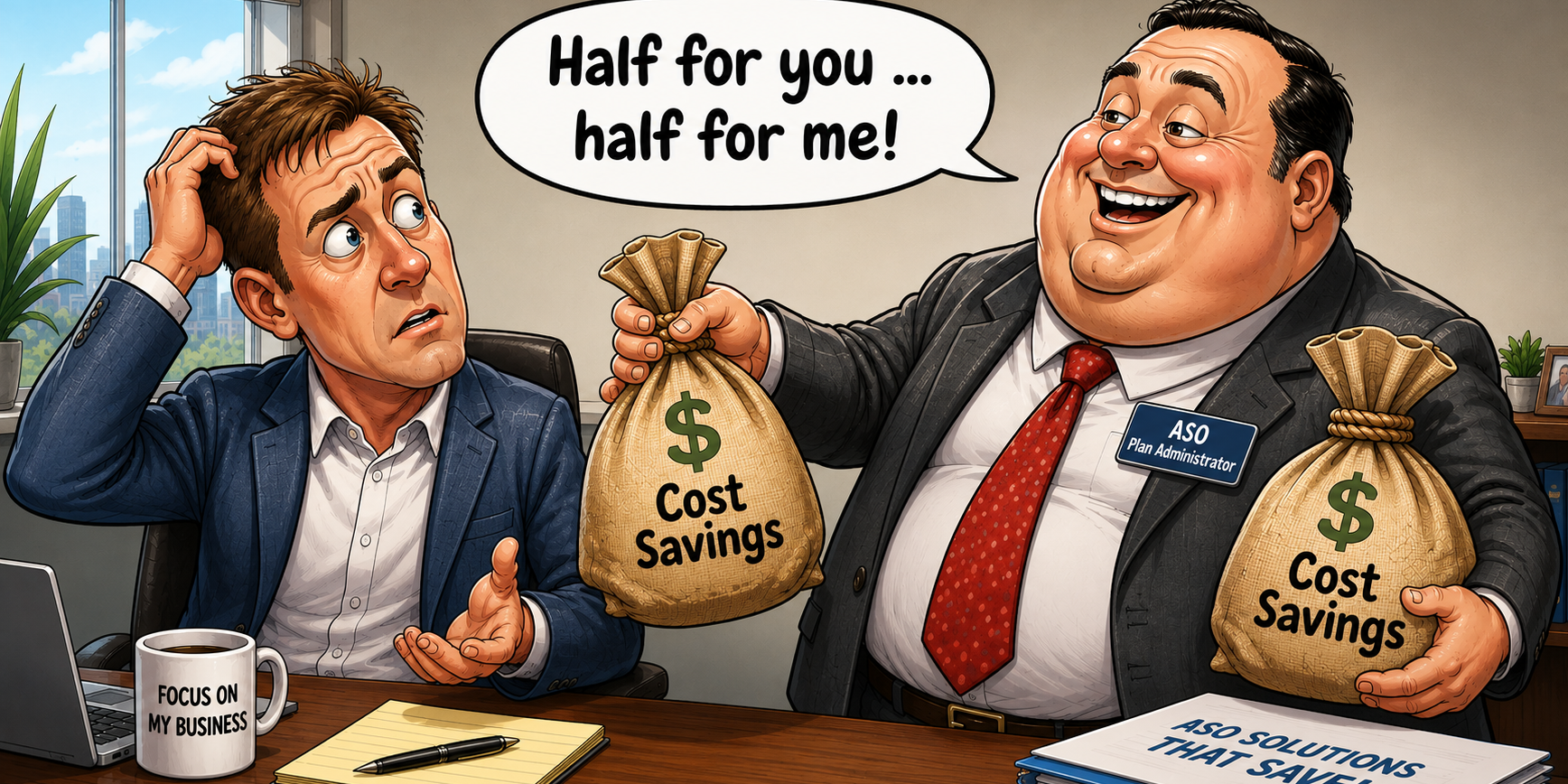
Who’s Keeping the Money They’re Supposed to Be Saving You?
When a company decides to self-fund its employee health plan, it usually feels like a smart move. Instead of handing a fixed premium to an insurance carrier every month and hoping for the best, the employer pays actual claims as they happen. In theory, this gives employers more control, more transparency, and more opportunity to save money. In practice, something important often gets buried in the fine print: the company hired to administer the plan is also quietly profiting every time something goes wrong with it.
That’s not a conspiracy. It’s written right into the contract.
What an ASO Contract Actually Says
When a large employer hires a Blue Cross, United, Cigna, Aetna, or another major carrier to administer their self-funded plan, they sign what’s called an Administrative Services Only agreement — an ASO contract. The employer takes on the financial risk. The carrier handles the paperwork, the network, the claims processing, and a long list of programs designed to catch errors, fraud, and overpayments.
Here’s where it gets interesting. Many of these programs — the ones designed to recover money that was paid incorrectly — are structured so that the administrator keeps a significant cut of whatever they find. The table shown here is a real-world example of exactly that. Look at what it says:
- National Advantage Program — the administrator retains 50% of savings
- Standard Facility Charge Review — the administrator retains 50% of savings
- Itemized Bill Review — the administrator retains 50% of savings
- Subrogation — the administrator retains up to 37.5% of recovered amounts
- Coordination of Benefits — the administrator retains up to 37.5% of recovered amounts
- Third Party Claim and Code Review — the administrator retains up to 37.5% of recovered amounts
Read that again. The company hired to process your claims correctly is keeping up to half of the money recovered when claims are processed incorrectly. And the employer — whose money was misspent in the first place — gets to split what’s left.
A Problem Built Into the Design
Let’s be clear about what this structure actually creates. When your plan administrator profits from recovering errors after the fact, they have a financial reason to let a certain level of error exist in the first place. Catching a billing mistake before a claim is paid eliminates the opportunity to split the recovery later. Finding it afterward generates revenue.
This is not a hypothetical. It is a documented feature of how many large carrier ASO programs are priced and structured.
Think about it this way. You hire a contractor to build your house. You later discover some of the work was done wrong. The contractor offers to fix it — but only if they keep half the value of everything they repair. And the contract you signed already agreed to those terms. Would you call that a trustworthy arrangement? Or would you call it a reason to wonder whether the mistakes were really so accidental?
The Misaligned Incentive Nobody Talks About
The question that benefits professionals, CFOs, and plan sponsors rarely ask out loud is this: why isn’t the administrator paid to get it right the first time?
A well-designed contract would compensate the administrator for accuracy, not recovery. It would reward them for catching upcoding, billing errors, and coordination of benefits issues before the claim is paid — not after. It would structure fees around the quality of their work, not around a percentage of whatever they can claw back from money that already left your account.
Instead, most conventional ASO contracts do the opposite. They create a situation where the administrator’s financial interest and the employer’s financial interest are not the same. The employer wants every dollar protected. The administrator, under this model, makes more money when dollars slip through and have to be chased down later.
This is a conflict of interest. It is legal, common, and almost universally accepted. It is also something that most HR departments, CFOs, and CEOs have never been shown in plain language — because the people explaining the contract are the same ones who benefit from it.
What Employers Should Be Asking
If your organization is self-funded — or considering it — these are the questions worth putting directly to your administrator or broker:
- What percentage of recovered funds does our administrator keep, and under which programs?
- What is our administrator’s financial incentive to catch errors before payment versus after?
- When were these recovery percentages last benchmarked against the market?
- Is our advisor being paid to find us a better structure, or are they tied to the carriers offering this one?
Most employers will not get clean answers to these questions without pushing hard. That alone should tell you something.
The Bottom Line
Self-funding was supposed to put the employer in the driver’s seat. For many organizations, that promise has been quietly hollowed out by contracts that split recoveries, reward errors after the fact, and leave the plan administrator with a financial stake in imperfect claims management.
Paying your administrator well to do the job right the first time is not a radical idea. It is just a better business arrangement than the one most employers are currently living with — and most of them don’t even know it yet.
