

There’s a saying I heard a few years back and it’s now making the rounds in HR circles: “Brokers make you broke-er, that’s why employers need a Benefits Consultant.” It’s catchy — maybe a little harsh — and it points to something real: too many organizations are spending far more than they should on their employee health insurance plan. A big reason why is that the people who should be working together on this — the CEO, CFO, and HR leader — are each pulled in different directions, while nobody’s really minding the store.
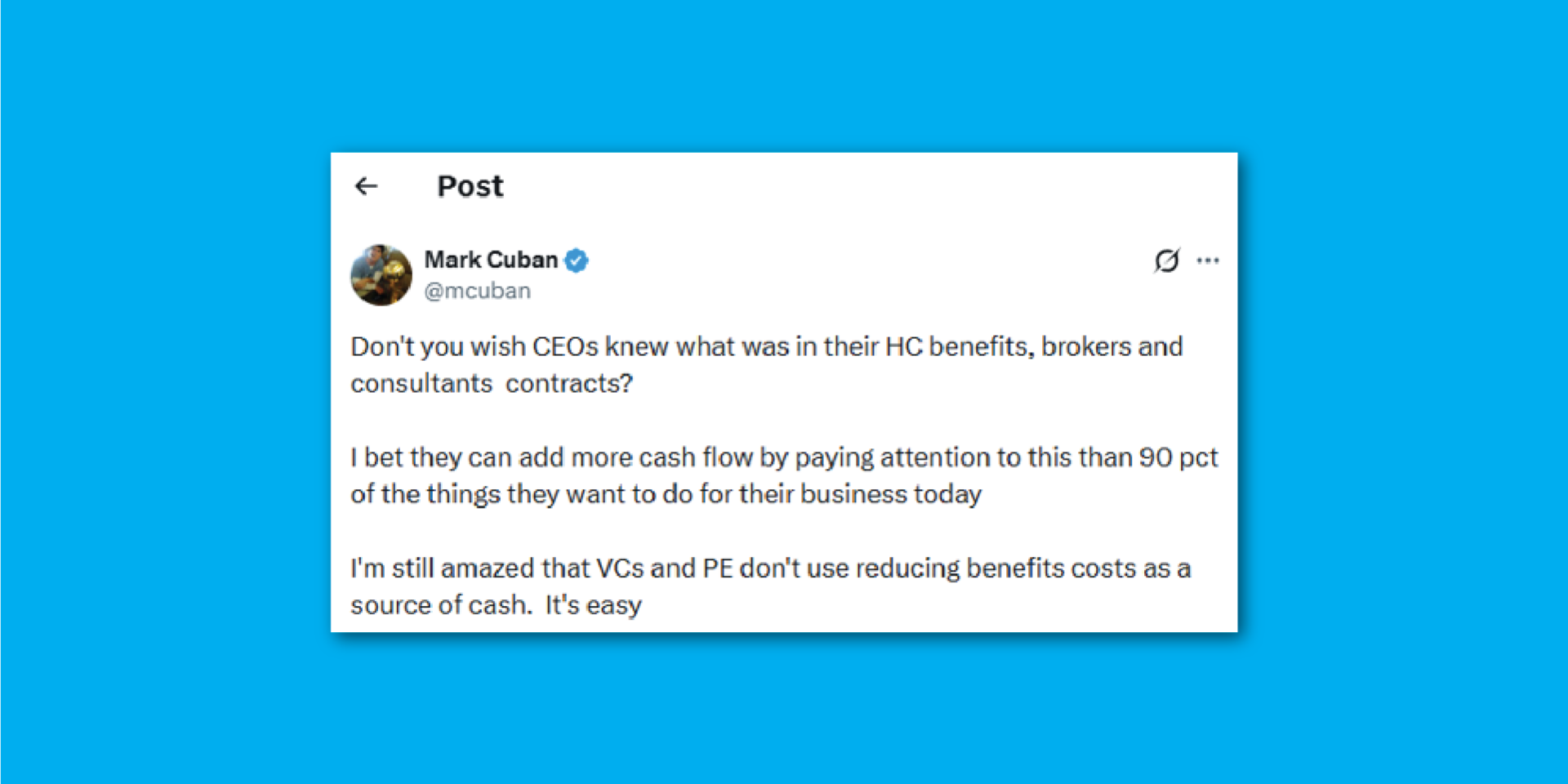
Last week, Mark Cuban noticed. In a recent post on X, he wrote: “Don’t you wish CEOs knew what was in their HC [healthcare] benefits, brokers and consultants contracts? I bet they can add more cash flow by paying attention to this than [90%] of the things they want to do for their business today.” Cuban then went further, suggesting that VCs and PE firms are leaving money on the table by ignoring benefits costs as a source of cash. I think he’s right — and the reasons why this keeps happening are worth understanding.
Three Leaders, Three Different Problems
Walk into most companies and ask who “owns” the benefits program. You’ll get three different answers depending on who you ask.
HR will tell you they own it — and they’re right that they handle most of the day-to-day. But if we’re being honest, their primary goal is often just to maintain employee satisfaction and minimize disruption, under the assumption that Quiet Inbox = Happy Employees. That’s understandable. Benefits are complicated and emotional, and who wants to manage angry staff because their doctor is suddenly out-of-network? HR tends to stick with last year’s Status Quo, even when last year’s plan is quietly draining the company’s budget, while employees have apathetically surrendered to the Byzantine Pre-Certification and Appeals processes of the Status Quo plan.
The CFO has their eye on the budget, where it should be. Sometimes the focus is too short of a time horizon: what does this cost this plan year? That thinking can lead to cuts that save money upfront but cost more later. Shifting costs to employees, picking a cheaper network, trimming EAP or mental and behavioral telehealth programs [Hello Mental Health Parity NQTLS!]— these choices look good on a spreadsheet in October but show up in worsening turnover, productivity, and morale by March.
Where is the CEO? Sometimes their involvement in benefits is skewed toward personal experience, existing relationships, or a preference for well-known providers. Over-generalizing: the Status Quo coverage works well for their own family so it must be working for everyone else. Mixing Friendship with Business: maybe a family member or college roommate is a broker and controls the business as a favor. Safety: “Nobody ever got fired for buying IBM” so let’s sign with a big-name firm because the brand felt safe, even if that big-name received some extra press as the broker on the recent fiduciary liability lawsuits.
While none of this is malicious, it’s not strategic and it’s not collaborative.
The Gap Nobody Talks About
Here’s what’s missing: a shared conversation between all three of these leaders, built around a real strategy rather than each person’s individual priority.
When HR, the CFO, and CEO don’t talk to each other — really talk, with data on the table — the company ends up with a benefits program that is pieced together rather than planned. The broker (or consultant, or vendor) fills that gap, and not always in your favor. Brokers are typically paid through commissions baked into your premiums. In this arrangement, the more you spend, the more they make. That’s not a scandal — it’s just how the model works. But it means your typical broker may not be fully motivated to find you the best deal.
By contrast, an independent, fee-based benefits consultant works for you. They’re paid directly by the employer, not by the insurance carrier. Their job is to understand your workforce, your claims data, your risk tolerance, and your budget — and build a plan with your goals in mind. That’s a very different relationship.
What This Means for Your Organization — Specifically
The financial stakes look different depending on what kind of organization you lead — but they’re high for everyone.
For private equity and venture-backed companies, this is a pure EBITDA conversation. Every dollar saved on benefits spending flows directly to the bottom line. Using a typical exit multiple of 6x to 12x EBITDA, $1M in annual benefits savings doesn’t just save $1M — it can add $6M to $10M in enterprise value at the time of sale. Cuban was pointing directly at this. PE and VC firms that treat benefits as a cost center to be optimized — not just a bill to be paid — are building value in a place most of their competitors haven’t even considered.
For nonprofits and public entities, the math is just as compelling, but the language is different. These organizations don’t chase multiples — they chase mission. Every dollar saved on health insurance premiums is a dollar that can go toward programs, services, staff, and our local communities. A school district, a county agency, or a social services nonprofit that reduces its benefits spend by $500K per year isn’t just saving money. We’re funding teachers, caseworkers, new roads and sidewalks, or water treatment upgrades. Benefits efficiency is mission alignment.
For organizations of nearly every size and setup, our message is the same: the cash flow opportunity sitting inside your benefits program is likely larger than almost anything else on your to-do list this year.
What Real Collaboration Looks Like
When a CEO, CFO, and HR leader get aligned on benefits, a few things change right away.
First, they make joint decisions with actual data instead of gut feel. How much is the company spending per employee? What are the top cost drivers in last year’s claims? Is the current network serving employees, steering to higher quality providers, or just looking good on a “disruption report”? These are questions that HR alone can’t answer, that Finance may not have been taught to ask, and that the CEO didn’t know was controllable until a true Benefits Advisor brings it to the table.
Second, they weigh short-term and long-term costs together. A CFO’s instinct to cut costs this year is valid — but the right HR leader can show what cutting coverage without a safety net and communication plan does to retention. The CEO can set the tone that benefits are part of the company’s culture and talent strategy, not just a line item, so let’s create win-win savings opportunities.
Third, they should review vendor relationships with clear eyes. Is your current broker or consultant actually performing? When, and how, did you last benchmark their work? Are you getting independent advice, or are you buying whatever they’re incentivized to sell?
It’s Time to Take Action
If you are a CEO, CFO, or HR leader — or you sit on a board, lead a nonprofit, or oversee a public agency — here is a simple challenge: schedule one meeting this quarter where all three leaders sit down together and look at your benefits program with fresh eyes. Pull the last five years’ spend, what’s the trend? Review your consultant or broker agreement and understand exactly how they are being paid. Ask whether your plan was built around your organization’s actual needs or around what was easiest to sell.
You don’t have to overhaul everything at once, nor should you. But you have to know where to start. The organizations winning on benefits aren’t doing anything exotic — they’re just paying attention. And as Mark Cuban put it, the payoff for paying attention here beats most of the other things on your list.
The money is there. The question is whether your leadership team is aligned enough to go get it. If not, let me know. I’m happy to help.
